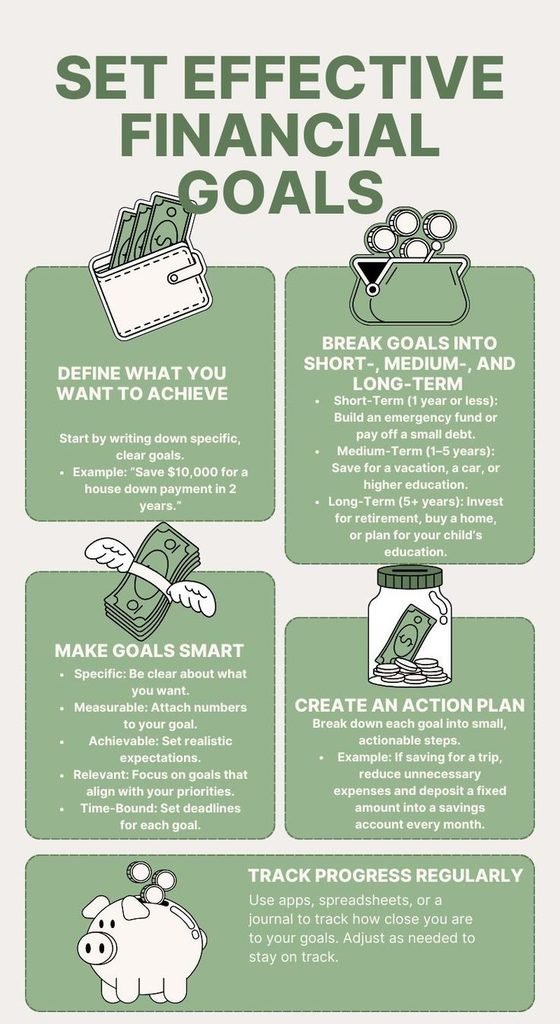
Having financial goals can make managing money much easier. Instead of simply trying to “save more” or “spend less,” you have a clear idea of what you are working toward and why it matters.
A financial goal could be something as simple as saving for an emergency fund, paying down debt, preparing for a large purchase, or building long-term savings. The important part is turning a general intention into a specific plan that you can follow.
Many people set financial goals at the beginning of the year and forget about them a few weeks later. The problem is often not a lack of motivation. It is that the goal was too vague, unrealistic, or difficult to track.
In this guide, you’ll learn how to create realistic financial goals, break them into manageable steps, track your progress, and adjust your plan when circumstances change.
What Are Financial Goals?
Financial goals are specific things you want to accomplish with your money.
They can be short-term, medium-term, or long-term.
Examples include:
- Saving $500 for emergencies
- Paying off a credit card balance
- Saving for a vehicle
- Building a larger emergency fund
- Saving for education
- Preparing for a holiday
- Reducing monthly expenses
- Increasing your savings rate
- Building long-term investments
- Reaching a specific savings amount
Your goals don’t have to involve large amounts of money.
Saving $100 can be a financial goal just as much as saving $10,000.
What matters is that the goal is meaningful and realistic for your circumstances.
Why Are Financial Goals Important?
Without a clear goal, it can be easy to spend money without thinking about your longer-term priorities.
For example, imagine you want to save $1,000 but haven’t decided when you want to reach that amount.
You might save occasionally, spend some of the money, and eventually lose track of your progress.
A specific goal creates direction.
Financial goals can help you:
- Give your money a purpose
- Stay focused on important priorities
- Make better spending decisions
- Measure your progress
- Develop consistent saving habits
- Prepare for unexpected expenses
- Reduce financial stress
- Make larger financial decisions more intentionally
The goal isn’t to become obsessed with every dollar.
It’s to have a clearer understanding of what you want your money to accomplish.
Step 1: Identify What Matters Most to You
Before deciding how much money you need, think about what you actually want to achieve.
Ask yourself:
- What would improve my financial situation?
- What expenses am I preparing for?
- What financial problems do I want to solve?
- What would make me feel more financially secure?
- What do I want my money to help me accomplish?
Your answers can help you identify your priorities.
For one person, the priority might be building an emergency fund.
For another, it might be paying off debt.
Someone else may be focused on saving for education, a home, transportation, or another major expense.
There is no single list of financial goals that works for everyone.
Step 2: Separate Short-Term and Long-Term Goals
Not every financial goal has the same time frame.
Separating goals by time can make them easier to organize.
Short-Term Goals
These are goals you hope to accomplish relatively soon.
Examples include:
- Saving for a bill
- Building an initial emergency fund
- Paying off a small balance
- Saving for a holiday
- Covering an upcoming purchase
Medium-Term Goals
These may take several months or a few years.
Examples include:
- Saving for a vehicle
- Paying off larger debts
- Building a larger emergency fund
- Saving for education
- Preparing for a major purchase
Long-Term Goals
These generally require years of planning.
Examples include:
- Long-term retirement savings
- Purchasing a home
- Building long-term investments
- Funding future education
- Reaching a significant financial milestone
Understanding the time frame helps you decide how much you need to set aside and how often you should review your progress.
Step 3: Make Your Goal Specific
“Save money” is a good intention, but it isn’t a very useful goal.
A better goal is specific.
Instead of:
“I want to save more money.”
Try:
“I want to save $1,000 for an emergency fund.”
Now you know exactly what you’re working toward.
You can make it even more useful by adding a time frame:
“I want to save $1,000 over the next 10 months.”
This gives you a target and a deadline.
Step 4: Give Your Goal a Deadline
A deadline creates a point at which you can measure whether you are on track.
For example:
Goal: Save $600
Deadline: 12 months
You could divide the target across the year:
$600 ÷ 12 = $50 per month.
Instead of thinking about the entire $600 at once, you now have a smaller monthly target.
If $50 per month isn’t realistic, you can extend the deadline or reduce the goal.
The purpose of a deadline isn’t to create unnecessary pressure.
It is to give your plan structure.
Step 5: Break Large Goals Into Smaller Steps
Large financial goals can feel intimidating.
Breaking them into smaller milestones makes them easier to manage.
Suppose your goal is to save $2,400.
Instead of focusing only on $2,400, you could create milestones:
First milestone: $200
Second milestone: $500
Third milestone: $1,000
Fourth milestone: $1,500
Final goal: $2,400
Each milestone gives you an opportunity to recognize your progress.
You can also divide the goal by month or paycheck.
If you want to save $2,400 over 12 months:
$2,400 ÷ 12 = $200 per month.
The calculation gives you a practical starting point.
Step 6: Check Your Current Budget
Your financial goal needs to fit into your actual budget.
Look at:
- Monthly income
- Housing
- Food
- Transportation
- Utilities
- Debt payments
- Insurance
- Subscriptions
- Entertainment
- Other regular expenses
Then determine how much money is realistically available for your goal.
For example, if you have $300 left after essential expenses and your goal requires $200 per month, you may have enough room.
But if you only have $50 available, you may need to adjust the goal.
You could:
- Extend the deadline
- Reduce another expense
- Increase income
- Lower the target temporarily
- Combine several approaches
A realistic goal is more useful than a goal that looks impressive but cannot be maintained.
Step 7: Decide Where the Money Will Come From
Once you know how much you need, decide how you’ll fund the goal.
You could use:
- Part of your regular income
- Automatic savings
- Money saved from reducing expenses
- Overtime income
- Freelance income
- Money from selling unused items
- Bonuses
- Other legitimate additional income
For example, suppose you want to save $100 per month.
You might decide:
$50 from regular income
$25 from reducing unnecessary spending
$25 from additional income
=
$100 per month.
Breaking the target into sources can make it feel more achievable.
Step 8: Automate Your Savings
Automation can make financial goals easier to maintain.
Instead of remembering to transfer money every month, you can schedule an automatic transfer if your bank or financial institution provides that feature.
For example, if you want to save $100 per month, you could arrange:
$50 after the first payday
$50 after the second payday
=
$100 per month.
Over 12 months:
$100 × 12 = $1,200.
Make sure automatic transfers don’t cause you to miss essential payments or overdraw your account.
Choose an amount that fits comfortably within your budget.
Step 9: Create Separate Savings Categories
If you have several financial goals, keeping everything in one general savings balance can make it difficult to know how much belongs to each goal.
You could organize savings into categories such as:
- Emergency fund
- Vehicle
- Education
- Holiday
- Home expenses
- Large purchase
- Long-term savings
Some banks offer separate savings spaces, pots, or sub-accounts.
If your bank doesn’t provide these features, a spreadsheet or simple budgeting system can help you track different goals.
The purpose is to make your progress visible.
Step 10: Track Your Progress
A goal becomes much easier to manage when you can see how you’re progressing.
For example:
Goal: $1,000
Month 1: $100
Month 2: $200
Month 3: $300
Month 4: $400
Month 5: $500
Seeing the balance increase can provide motivation to continue.
You can track your progress using:
- A spreadsheet
- A notebook
- A budgeting application
- A savings account
- A simple monthly checklist
Choose whatever method you are most likely to use consistently.
Step 11: Reduce Obstacles
Sometimes achieving a financial goal isn’t about earning more.
It is about making the goal easier to follow.
Look for things that repeatedly interfere with your plan.
For example:
- Frequent impulse purchases
- Unused subscriptions
- Unplanned restaurant spending
- Shopping without a list
- Using savings for everyday expenses
- Forgetting upcoming bills
If you identify a particular problem, create a specific solution.
For example, if online shopping regularly affects your savings goal, you could introduce a 24-hour waiting period before making nonessential purchases.
Small changes can make your financial plan easier to maintain.
Step 12: Use Unexpected Money Carefully
Unexpected money can give your financial goals a useful boost.
Examples include:
- Bonuses
- Overtime
- Refunds
- Gifts
- Money from selling unused items
- Temporary additional income
You don’t necessarily need to put all unexpected money into savings.
Instead, decide how much should go toward your current priorities.
For example:
$300 unexpected income
→ $150 toward savings
→ $100 toward debt
→ $50 for personal spending
The exact amounts depend on your circumstances.
Step 13: Prioritize Your Goals
Trying to accomplish ten financial goals at the same time can become overwhelming.
Instead, decide which goals are most important.
For example:
Priority 1
Build an initial emergency fund.
Priority 2
Pay down high-cost debt.
Priority 3
Build additional savings.
Priority 4
Work toward larger long-term goals.
Your priorities may be different.
The important thing is to know what comes first.
Step 14: Review Your Goals Regularly
Your financial situation can change.
You might:
- Earn more money
- Earn less money
- Change jobs
- Move
- Take on new expenses
- Pay off debt
- Start a family
- Have an unexpected expense
When circumstances change, your goals may need to change too.
Review your goals at least once a month or whenever something significant changes.
Ask:
- Am I still working toward the right goal?
- Am I saving enough?
- Is my deadline realistic?
- Have my expenses changed?
- Can I increase my contribution?
- Do I need to adjust my target?
Adjusting your plan isn’t failure.
It is part of responsible financial planning.
Step 15: Celebrate Progress Without Destroying It
Reaching a financial milestone is worth recognizing.
However, be careful not to celebrate by immediately spending all the money you’ve saved.
If you reach $500 toward a $1,000 goal, for example, acknowledge the achievement while keeping your larger objective in mind.
You could celebrate with something inexpensive or simply recognize the progress you’ve made.
The goal is to build a habit that lasts beyond one financial milestone.
Examples of Realistic Financial Goals
Here are several examples of how a general intention can become a practical goal.
Example 1: Emergency Fund
Instead of:
“I need emergency savings.”
Try:
“I will save $500 over the next five months by setting aside $100 each month.”
Example 2: Large Purchase
Instead of:
“I want a new computer.”
Try:
“I will save $1,200 over 12 months by setting aside $100 each month.”
Example 3: Debt Reduction
Instead of:
“I want to get rid of my debt.”
Try:
“I will pay an additional $75 per month toward my target debt balance while continuing to make required payments.”
Example 4: Reducing Expenses
Instead of:
“I need to spend less.”
Try:
“I will reduce restaurant spending by $50 per month and redirect that money toward savings.”
What If You Miss Your Goal?
Missing a monthly target doesn’t mean the entire plan has failed.
Unexpected expenses happen.
Your income may change.
You may simply have a month where your priorities are different.
Instead of abandoning the goal, ask:
What caused me to fall behind?
If the target was unrealistic, adjust it.
If an unexpected expense caused the problem, rebuild your plan.
If unnecessary spending caused it, identify the spending pattern and make a change.
The important thing is to return to the plan rather than giving up completely.
Common Financial Goal-Setting Mistakes
Setting Too Many Goals
Trying to save for everything at once can spread your money too thin.
Choose a manageable number of priorities.
Choosing Unrealistic Targets
A goal that requires more money than you can reasonably spare is unlikely to last.
Having No Deadline
Without a time frame, it can be easy to keep postponing the goal.
Not Tracking Progress
If you never check your progress, it becomes harder to know whether your strategy is working.
Using Savings for Everyday Spending
Keep your goal-specific savings separate from your normal spending money when practical.
Giving Up After a Setback
One difficult month doesn’t erase your previous progress.
Focusing Only on the Final Number
Large goals become easier when you recognize smaller milestones along the way.
A Simple Financial Goal Template
You can use this structure for almost any financial goal:
My goal: ______________________
Amount needed: ______________________
Current amount: ______________________
Amount remaining: ______________________
Deadline: ______________________
Monthly target: ______________________
Weekly or payday target: ______________________
Where the money will come from: ______________________
How I will track progress: ______________________
What could interfere with my goal: ______________________
How I will handle setbacks: ______________________
Writing this down turns a vague idea into a practical plan.
A 30-Day Financial Goal Challenge
If you want to start immediately, use the following four-week approach.
Week 1: Choose
Choose one financial goal that matters to you.
Write down the amount you need and your desired deadline.
Week 2: Plan
Review your budget and determine how much you can realistically contribute.
Look for one or two expenses you could reduce if necessary.
Week 3: Start
Make your first contribution toward the goal.
If possible, set up an automatic transfer for future contributions.
Week 4: Review
Check your progress.
Ask yourself:
- Did I contribute the planned amount?
- Was the target realistic?
- What made saving easier?
- What made it difficult?
- What should I change next month?
Then continue the process.
Leave a Reply