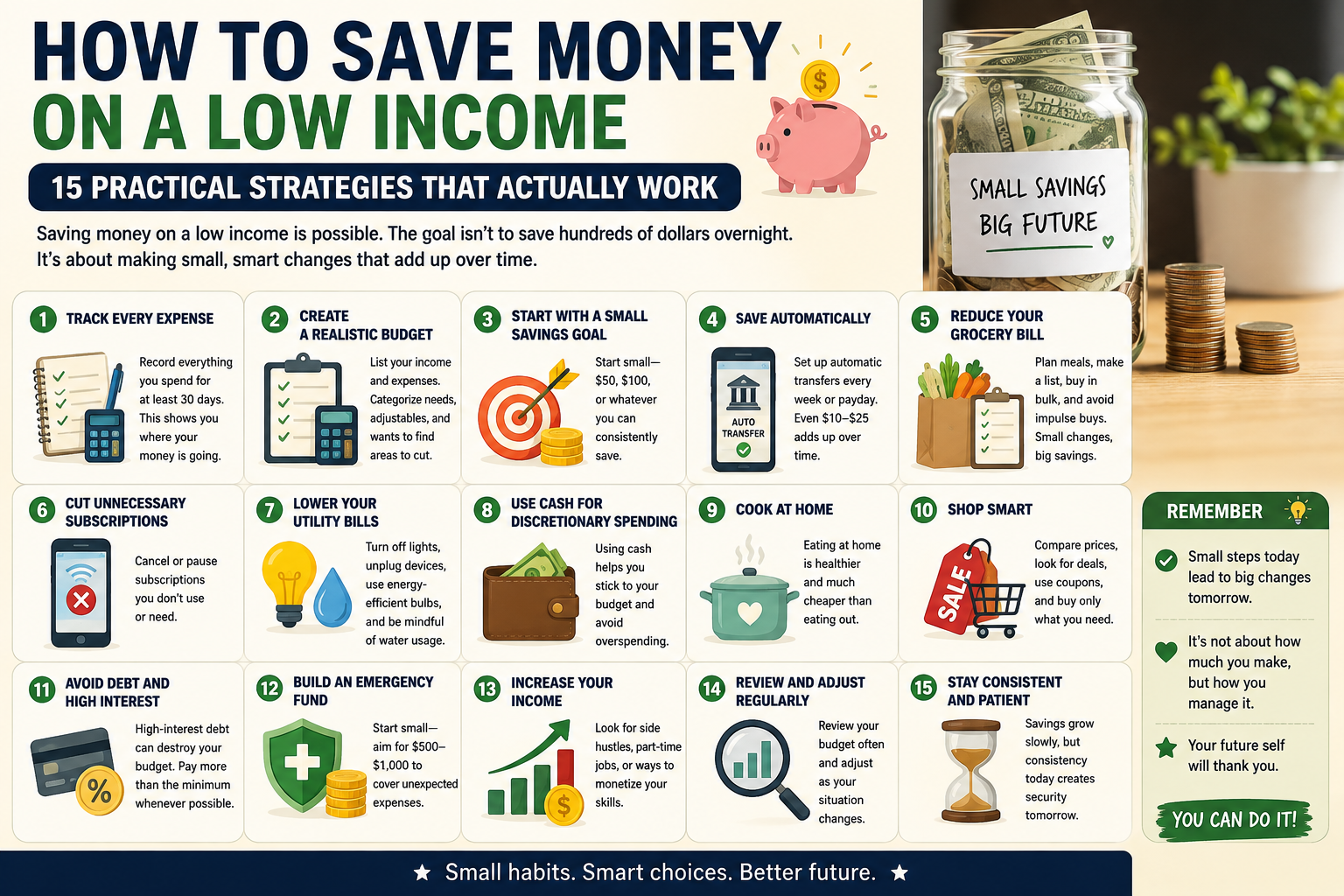
Saving money can feel almost impossible when your income is barely enough to cover your monthly expenses.
You may have rent, groceries, transportation, utility bills, debt payments, and other necessities competing for the same limited amount of money. By the time everything is paid, there may seem to be nothing left to save.
But saving money on a low income is possible.
The goal isn’t to suddenly save hundreds of dollars every month. Instead, focus on finding small amounts of money you can consistently set aside while making your everyday finances easier to manage.
Even a small amount of savings can give you more breathing room when an unexpected expense appears.
In this guide, you’ll learn practical ways to save money when your income is limited, including how to reduce expenses, create a realistic budget, automate savings, avoid unnecessary spending, and increase your income.
Can You Really Save Money on a Low Income?
Yes.
However, saving on a low income requires a realistic approach.
You may not be able to eliminate your biggest expenses immediately. If rent takes up a large portion of your income, for example, cutting out one small purchase won’t completely transform your finances.
Instead, look at your entire financial situation.
Ask yourself:
- How much money comes into my household each month?
- What are my essential expenses?
- Which expenses can I reduce?
- Where does my money disappear without me noticing?
- Can I increase my income?
- How much can I realistically save each week or month?
The first goal isn’t perfection.
The first goal is creating a small gap between what you earn and what you spend.
Once that gap exists, you can direct some of it toward savings.
1. Start by Tracking Every Expense
Before trying to save money, find out exactly where your money is going.
For at least 30 days, record everything you spend.
This includes:
- Rent or mortgage
- Groceries
- Restaurants
- Transportation
- Utilities
- Phone bills
- Subscriptions
- Online shopping
- Entertainment
- Debt payments
- Insurance
- Small daily purchases
Don’t ignore small expenses.
A $5 purchase may not seem important, but several small purchases throughout the week can become a significant monthly expense.
You can use a spreadsheet, budgeting app, notebook, or your bank statements.
The method doesn’t matter as much as being consistent.
Once you know where your money is going, you’ll have a much better idea of where you can make changes.
2. Create a Realistic Budget
A budget isn’t designed to stop you from enjoying your money.
A good budget simply tells your money where to go before you spend it.
Start by writing down your monthly take-home income.
Then list your expenses and divide them into three categories.
Essential Expenses
These are expenses you generally need to maintain your basic standard of living.
Examples include:
- Housing
- Basic groceries
- Utilities
- Transportation
- Insurance
- Minimum debt payments
- Necessary medical expenses
Important but Adjustable Expenses
These expenses may not be completely optional, but you may be able to reduce them.
Examples include:
- Phone plans
- Internet
- Transportation costs
- Grocery spending
- Insurance costs
Discretionary Expenses
These are expenses you can potentially reduce or eliminate.
Examples include:
- Entertainment
- Takeout
- Shopping
- Streaming services
- Hobbies
- Unplanned purchases
Once you categorize your spending, you’ll have a clearer idea of where you can make changes.
3. Start With a Small Savings Goal
One of the biggest mistakes people make is setting an unrealistic savings target.
If you’re earning a low income, saying, “I’m going to save $500 every month,” may be impossible.
Instead, start smaller.
Your first goal could be:
- $50
- $100
- $250
- $500
- $1,000
Choose an amount that feels challenging but achievable.
For example, if you save $25 every week:
$25 × 52 weeks = $1,300 per year.
You don’t need to save a huge amount at once.
Consistency matters more than trying to make one large deposit.
4. Save Automatically
One of the easiest ways to make saving consistent is to automate it.
Instead of waiting until the end of the month to see what’s left, move a small amount into savings when you receive your income.
For example:
- $10 every week
- $25 every payday
- $50 twice a month
If your bank allows automatic transfers, set one up.
For example, if you’re paid twice a month and automatically save $25 each payday:
$25 × 2 = $50 per month.
$50 × 12 = $600 per year.
That’s $600 you may not have saved otherwise.
If $25 is too much, start with $5 or $10.
The important thing is to start.
5. Reduce Your Grocery Bill
Food is one area where many households can find savings.
This doesn’t mean starving yourself or eating unhealthy food.
Instead, make your grocery spending more intentional.
Try these strategies:
- Plan meals before shopping.
- Create a grocery list.
- Compare prices between stores.
- Buy store brands when they’re a good value.
- Cook larger portions and save leftovers.
- Use food you already have before buying more.
- Reduce unnecessary convenience foods.
- Check unit prices instead of only looking at package prices.
- Avoid shopping when you’re hungry.
- Use coupons or store promotions for products you actually need.
You don’t need to cut your grocery bill in half.
If you can reduce it by $25 per month, that’s still $300 per year.
6. Cancel Unused Subscriptions
Subscriptions can quietly drain your bank account.
Go through your bank or credit card statements and look for recurring charges.
You may find subscriptions you:
- Forgot about
- Rarely use
- No longer need
- Signed up for during a promotion
Ask yourself:
“Would I buy this subscription again today?”
If the answer is no, consider canceling it.
If five subscriptions cost $10 each, that’s $50 per month.
Canceling just two could free up $20 every month.
That’s $240 per year.
7. Reduce Your Monthly Bills
Don’t assume your current bills are permanent.
Review your recurring expenses and see whether there are cheaper options.
Consider comparing:
- Phone plans
- Internet plans
- Insurance
- Streaming services
- Banking fees
- Energy costs
- Transportation expenses
You can also contact service providers and ask whether they have cheaper plans.
The goal isn’t necessarily to cancel everything.
It’s to make sure you’re not paying more than necessary for the services you actually use.
8. Use the 24-Hour Rule for Nonessential Purchases
Impulse spending can make saving extremely difficult.
A simple way to slow yourself down is to create a waiting period.
Before buying something you don’t need, wait 24 hours.
For more expensive purchases, consider waiting a week.
During that time, ask yourself:
- Do I actually need this?
- Can I afford it without using debt?
- Will I still want it next week?
- Do I already own something similar?
- Would I rather put this money toward one of my financial goals?
Sometimes you’ll discover that you don’t really want the item.
You simply wanted the excitement of buying something.
9. Have No-Spend Days
A no-spend day means you intentionally avoid unnecessary purchases for one day.
You still pay for genuine necessities.
For example, you might decide:
“Today, I won’t spend money on restaurants, shopping, entertainment, or unnecessary online purchases.”
Try starting with one or two no-spend days each week.
You can eventually experiment with a no-spend weekend or a longer no-spend challenge.
The purpose isn’t to punish yourself.
It’s to become more conscious of your spending habits.
10. Set Spending Limits for Problem Categories
If you repeatedly overspend in a particular category, create a specific limit.
For example, suppose you usually spend $200 per month on eating out.
Instead of relying entirely on willpower, give yourself a fixed amount.
Once that money is gone, stop spending in that category until the next budget period.
You can do this with cash, a separate account, or a budgeting system.
A spending limit makes your budget more concrete.
11. Reduce Transportation Costs
Transportation can consume a large part of a household’s income.
Look for opportunities to reduce the cost.
Depending on where you live, you might:
- Use public transportation.
- Walk for short trips.
- Carpool.
- Combine errands.
- Maintain your vehicle properly.
- Compare fuel prices.
- Reduce unnecessary driving.
- Work remotely when possible.
Even small changes can add up.
For example, combining several errands into one trip can reduce fuel use and save time.
12. Find Ways to Increase Your Income
Saving isn’t only about cutting expenses.
Sometimes there simply isn’t enough income to cover everything comfortably.
If you’ve already reduced unnecessary expenses, consider looking for ways to earn more.
Possible options include:
- Part-time work
- Freelancing
- Selling unused items
- Online work
- Weekend work
- Tutoring
- Pet sitting
- Childcare
- Delivery work
- Using an existing skill to provide a service
You don’t necessarily need a second full-time job.
An additional $100 or $200 per month can make a meaningful difference.
If you earn extra money, give it a specific purpose instead of allowing it to disappear into everyday spending.
For example:
$150 extra income → $100 savings + $50 debt repayment.
13. Save Unexpected Money
Whenever you receive money you weren’t expecting, consider saving at least part of it.
Examples include:
- Tax refunds
- Work bonuses
- Cash gifts
- Rebates
- Money from selling unused items
- Overtime pay
- Side-hustle income
You don’t have to save 100% of every unexpected dollar.
You could decide to save 50% and use the rest for another financial goal or something you enjoy.
The important thing is to avoid treating every unexpected dollar as money that must immediately be spent.
14. Build an Emergency Fund
Saving money isn’t just about buying something you want later.
It’s also about protecting yourself from unexpected expenses.
An emergency fund is money set aside specifically for unexpected expenses such as certain car repairs, home repairs, medical expenses, or a loss of income.
If you’re starting from zero, don’t worry about having several months of expenses immediately.
Start with a small target.
Stage 1: Save $100
Your first goal is simply to create a small financial cushion.
Stage 2: Save $500
Now you have more protection against smaller unexpected expenses.
Stage 3: Save $1,000
This gives you a stronger buffer for many common financial surprises.
Stage 4: Build a Larger Emergency Fund
Once your financial situation improves, you can work toward a larger emergency fund based on your income, expenses, job stability, household situation, and other needs.
There isn’t one emergency-fund amount that works for everyone.
The right target depends on your circumstances.
15. Don’t Try to Change Everything at Once
This might be the most important tip.
You don’t need to completely transform your financial life in one month.
Trying to cut every expense at once can leave you frustrated and make it harder to maintain your new habits.
Instead, choose two or three changes.
For example:
Month 1
- Track every expense.
- Cancel two unused subscriptions.
- Save $25 per payday.
Month 2
- Reduce restaurant spending.
- Review your phone or internet plan.
- Increase savings by another $10 per payday.
Month 3
- Start a no-spend day each week.
- Find one way to earn extra income.
- Put some extra income into your emergency fund.
Small improvements can add up over time.
How Much Should You Save on a Low Income?
There’s no universal amount that everyone should save.
If your income barely covers your essential expenses, saving even a small amount can be meaningful.
For example:
| Monthly Income | Possible Starting Savings |
|---|---|
| $1,500 | $10–$30 |
| $2,000 | $20–$50 |
| $2,500 | $25–$75 |
| $3,000 | $50–$100 |
These aren’t strict financial rules.
They’re simply examples to show that you can start with an amount that fits your circumstances.
If your income or expenses change, adjust your savings amount.
The goal is to create a sustainable habit rather than choosing a number that causes you to fall behind on essential bills.
What If You Have Nothing Left to Save?
This is an important situation to acknowledge.
Sometimes the problem isn’t poor spending habits.
Sometimes your income genuinely isn’t enough to cover your basic expenses.
If you’ve already eliminated unnecessary spending and you’re still running a deficit, cutting another $5 from your budget may not solve the underlying problem.
In that situation, focus on two things.
1. Protect Your Essentials
Prioritize necessities such as:
- Housing
- Food
- Utilities
- Transportation
- Insurance
- Required debt payments
2. Look for Ways to Increase Your Income or Reduce Major Costs
This might involve:
- Looking for additional work
- Asking about additional hours
- Finding cheaper housing
- Reducing transportation costs
- Negotiating bills where possible
- Looking for assistance programs you may qualify for
- Speaking with creditors if you’re struggling with payments
There’s no shame in starting with $1, $5, or even focusing first on stabilizing your monthly finances.
Where Should You Keep Your Savings?
For short-term savings and emergency money, accessibility and safety are important.
A dedicated savings account at a bank or credit union may be appropriate for many people.
Keeping emergency savings separate from your everyday spending account can also make it easier to avoid accidentally spending the money.
Before choosing an account, compare things such as fees, accessibility, interest rates, and applicable deposit protection.
Common Mistakes to Avoid When Saving on a Low Income
Mistake 1: Setting an Unrealistic Goal
If you can’t realistically save $500 a month, don’t make $500 your required target.
Start smaller.
Mistake 2: Ignoring Small Expenses
Small purchases can become significant when repeated frequently.
Mistake 3: Forgetting Irregular Expenses
Annual insurance payments, holidays, school costs, repairs, and other less frequent expenses should be considered when creating your budget.
Mistake 4: Using Your Savings for Everyday Spending
Give your savings a purpose.
If it’s your emergency fund, try to use it only for genuine emergencies.
Mistake 5: Giving Up After One Bad Month
Unexpected expenses happen.
If you have to use some of your savings, that doesn’t mean you’ve failed.
Rebuild it when you’re able.
Mistake 6: Focusing Only on Cutting Expenses
There is a limit to how much you can cut.
Increasing your income can eventually become more important than cutting another small expense.
A Simple 30-Day Money-Saving Challenge
If you want to start immediately, try this simple challenge.
Week 1: Track
Write down every purchase you make.
Don’t judge yourself yet.
Just collect the information.
Week 2: Cut
Choose three expenses you can reduce or eliminate.
For example:
- One subscription
- Two restaurant meals
- One unnecessary shopping category
Week 3: Save
Open or designate a savings account and transfer your first amount.
It could be $5, $20, $50, or whatever is realistic for you.
Week 4: Improve
Look at what you learned during the month.
Ask yourself:
- Where did I overspend?
- What was easy to cut?
- What was difficult?
- How much did I save?
- Can I repeat these changes next month?
- Can I increase my income?
Then create your next month’s target.
Leave a Reply