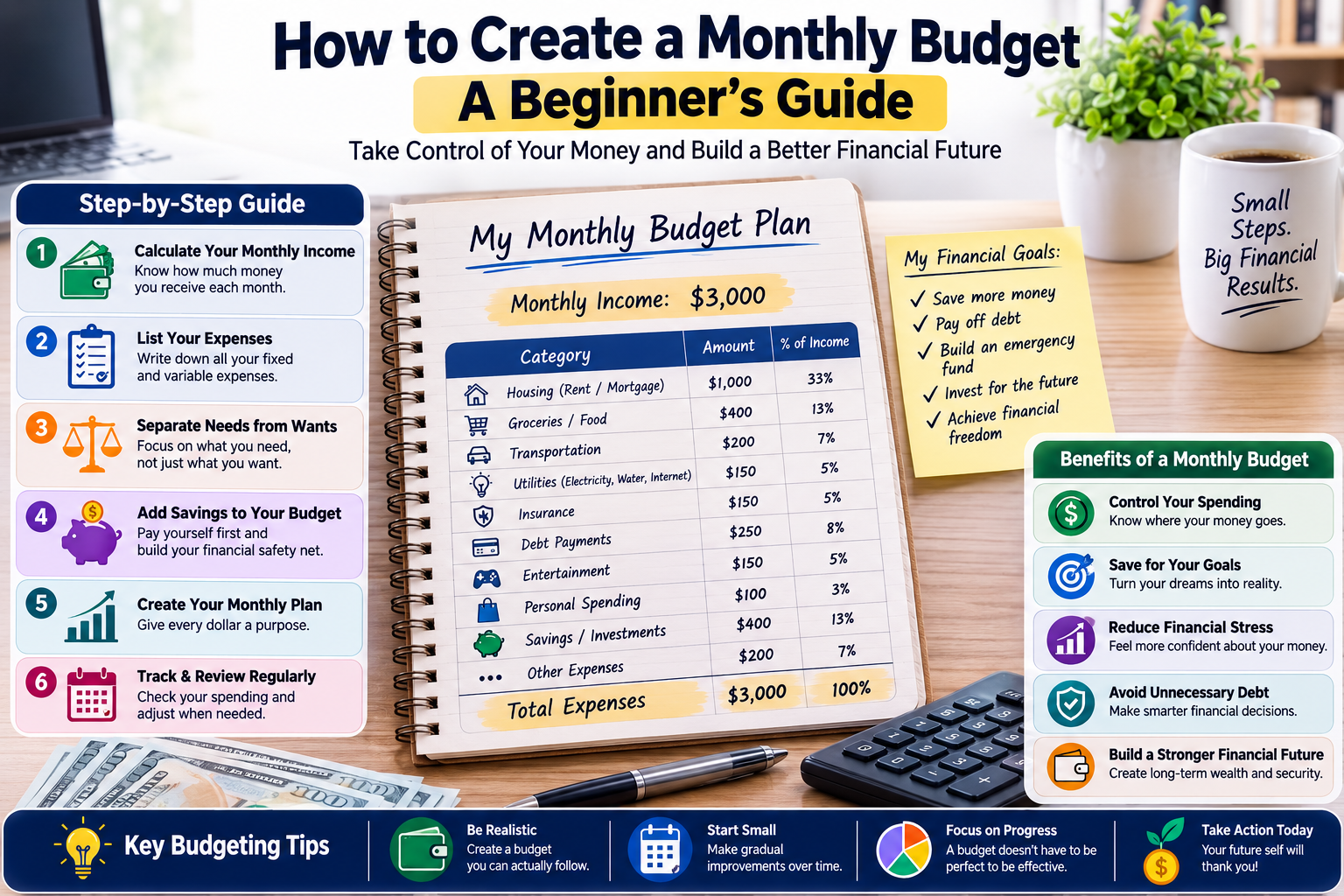
Managing money can feel difficult when you do not have a clear idea of where your income goes each month. You may pay your bills, buy groceries, use transportation, enjoy some entertainment, and make several small purchases without realizing how quickly everything adds up.
A monthly budget can help you take control of your money.
Creating a budget does not mean that you have to stop spending money or avoid everything you enjoy. Instead, a budget gives every part of your income a purpose. It helps you understand what you earn, what you spend, how much you can save, and where you may need to make changes.
The good news is that creating a monthly budget does not have to be complicated. You can start with a notebook, spreadsheet, calculator, or budgeting app.
In this beginner’s guide, you will learn how to create a monthly budget step by step and how to make it practical enough to use throughout the year.
What Is a Monthly Budget?
A monthly budget is a plan for how you intend to use your income during a particular month.
It usually includes three important things:
- Your total monthly income
- Your expected monthly expenses
- Your savings and financial goals
For example, imagine that your monthly take-home income is $3,000.
Instead of spending money throughout the month without a plan, you could create a budget that assigns money to housing, food, transportation, utilities, savings, entertainment, and other expenses.
The exact amounts will be different for everyone because everyone’s income, location, responsibilities, and financial goals are different.
The purpose of a budget is to make those numbers visible.
Why Is Creating a Monthly Budget Important?
A budget can help you make better decisions about your money because you can see your financial situation more clearly.
1. It Shows Where Your Money Goes
Without tracking your expenses, it can be surprisingly easy to lose track of your spending.
Small purchases may not seem important individually, but several small purchases throughout the month can add up.
A budget helps you identify these spending patterns.
2. It Helps You Avoid Overspending
When you know how much money is available for each category, you are less likely to spend without thinking about the consequences.
For example, if you have already reached your monthly entertainment limit, you can decide whether another purchase is worth reducing spending somewhere else.
3. It Makes Saving Easier
Saving money becomes much easier when it is included in your budget.
Instead of hoping that you will have money left over at the end of the month, you can plan for savings from the beginning.
4. It Helps With Financial Goals
Whether your goal is building an emergency fund, paying off debt, buying a car, traveling, or preparing for the future, a budget can help you determine how much you can put toward that goal each month.
Step 1: Calculate Your Monthly Income
The first step in creating a budget is knowing how much money you have available.
If you receive a regular salary, this may be relatively straightforward. Look at the amount you actually receive after taxes and other deductions rather than using your gross salary.
If you have multiple income sources, add them together.
Your income could come from:
- Employment
- Freelance work
- A small business
- Self-employment
- Part-time work
- Rental income
- Other regular sources
For example:
Salary: $2,500
Freelance income: $500
Total monthly income: $3,000
If your income changes from month to month, budgeting requires a little more planning.
In that situation, consider using a conservative estimate based on your typical income rather than assuming you will always earn your highest amount.
This can reduce the risk of creating a budget that depends on income you may not receive.
Step 2: List Your Fixed Expenses
Fixed expenses are costs that are usually the same or relatively predictable each month.
Common examples include:
- Rent or mortgage payments
- Insurance
- Loan payments
- Internet plans
- Phone plans
- Subscription services
- School or education payments
For example:
| Fixed Expense | Amount |
|---|---|
| Housing | $1,000 |
| Internet and phone | $100 |
| Insurance | $150 |
| Loan payment | $250 |
| Subscriptions | $50 |
| Total | $1,550 |
Your own expenses may be completely different.
The important thing is to write them down instead of relying on memory.
Step 3: Estimate Your Variable Expenses
Variable expenses are costs that can change from month to month.
Examples include:
- Groceries
- Transportation
- Electricity
- Gas
- Dining out
- Entertainment
- Clothing
- Personal care
- Household purchases
These expenses can be more difficult to budget because the amount may change.
One useful approach is to look at your spending from the previous two or three months.
If you normally spend between $350 and $450 on groceries, you could use an amount within that range as your starting budget.
After tracking your expenses for several months, you can make the estimates more accurate.
Step 4: Separate Needs From Wants
One of the most useful budgeting habits is learning the difference between needs and wants.
Needs
Needs are expenses that are important for your basic living, responsibilities, or ability to work and study.
They may include:
- Housing
- Basic food
- Essential transportation
- Utilities
- Necessary healthcare
- Insurance
- Minimum debt payments
- Essential education costs
Wants
Wants are things you enjoy but could potentially live without.
Examples include:
- Restaurant meals
- Entertainment
- New gadgets
- Expensive clothing
- Hobbies
- Vacations
- Streaming services
- Non-essential shopping
This does not mean that you should eliminate all wants.
A realistic budget should leave some room for enjoyment.
The goal is simply to understand the difference so that you can prioritize your money.
Step 5: Add Savings to Your Budget
Saving should be treated as part of your financial plan rather than something you do only when money happens to be left over.
Start with an amount that is realistic for your income.
For example, if you earn $3,000 per month, you might decide to save $300.
That is 10% of your monthly income.
If you can save more, great. If you can only save a smaller amount right now, that is also a starting point.
The important thing is to build the habit.
Your savings could be divided into different goals, such as:
Emergency Fund
Money reserved for unexpected expenses.
Short-Term Goals
Money for expenses you expect to make in the near future.
Long-Term Goals
Money for larger future objectives.
Keeping different goals in mind can make saving feel more purposeful.
Step 6: Include Debt Payments
If you have debt, make sure your monthly budget includes the required payments.
These might include:
- Credit card balances
- Personal loans
- Student loans
- Car loans
- Other forms of borrowing
At minimum, make sure you account for required payments.
If your budget allows, you can also allocate additional money toward paying down debt faster.
A budget can help you see whether there is money available for extra payments without sacrificing essential expenses.
Step 7: Create Your Monthly Budget
Now you can bring everything together.
Suppose someone earns $3,000 per month.
Their initial budget might look like this:
| Category | Planned Amount |
|---|---|
| Housing | $1,000 |
| Groceries | $400 |
| Transportation | $200 |
| Utilities | $150 |
| Insurance | $150 |
| Debt payments | $250 |
| Entertainment | $150 |
| Personal spending | $100 |
| Savings | $400 |
| Other expenses | $200 |
| Total | $3,000 |
This is only an example.
Your budget should be based on your actual income and expenses.
The most important thing is that your planned expenses do not exceed your available income.
Step 8: Give Every Dollar a Purpose
One useful budgeting principle is to give your income a purpose before the month begins.
If you earn $3,000, your plan should account for approximately that entire amount.
This does not necessarily mean that you have to spend every dollar.
Money assigned to savings is still money with a purpose.
For example:
Income: $3,000
Expenses: $2,400
Savings: $400
Extra financial goal: $200
Now the entire income has been assigned.
This approach can reduce the temptation to spend money simply because it is sitting in your account.
Step 9: Plan for Irregular Expenses
One mistake beginners often make is budgeting only for monthly bills.
Some expenses do not occur every month but still need to be paid eventually.
Examples include:
- Annual insurance payments
- Vehicle maintenance
- School expenses
- Holiday spending
- Gifts
- Home repairs
- Medical expenses
- Annual subscriptions
If you know an expense is coming, estimate the annual cost and divide it across the months.
For example, if you expect to spend $600 on vehicle maintenance and other vehicle-related expenses over a year, you could set aside approximately $50 per month.
When the expense eventually arrives, you will already have money available for it.
Step 10: Track Your Actual Spending
Creating a budget is only the beginning.
You also need to compare your plan with what you actually spend.
Suppose you planned to spend $400 on groceries but ended the month at $475.
That is useful information.
It does not necessarily mean you failed.
You may discover that your original estimate was simply too low.
The following month, you could adjust the grocery budget to reflect reality or look for ways to reduce the expense.
This process of planning, tracking, and adjusting is what makes a budget useful.
Step 11: Review Your Budget Every Week
You do not have to spend hours reviewing your finances every day.
A short weekly review can be enough.
Look at:
- How much you have spent
- How much remains in each category
- Whether any bills are coming up
- Whether you are on track with your savings goal
- Whether you need to adjust your spending
For example, if you have already spent most of your entertainment budget during the first two weeks of the month, you know that you need to slow down that category for the remaining weeks.
Small adjustments during the month are usually easier than trying to fix everything at the end.
Step 12: Adjust Your Budget When Your Life Changes
Your budget should not remain exactly the same forever.
Your income may increase.
Your rent may change.
You may start a new job.
You may have a new family responsibility.
You may pay off a loan.
Your financial goals may also change.
Whenever something important changes, review your budget and make adjustments.
A budget should reflect your current financial situation rather than an outdated version of your life.
Common Budgeting Mistakes to Avoid
Setting Unrealistic Limits
One of the biggest mistakes is creating a budget that looks good on paper but is impossible to follow.
If you normally spend $500 on groceries and suddenly set a $200 limit without changing your habits, you may struggle to stay within the budget.
Use your previous spending as a starting point and make gradual improvements.
Forgetting Small Expenses
A coffee, snack, app purchase, delivery fee, or small online purchase may not seem important.
But repeated small expenses can add up.
Record them.
Treating Savings as an Afterthought
If saving is important to you, include it in the budget from the beginning.
Do not simply save whatever happens to remain at the end of the month.
Giving Up After One Bad Month
Everyone can have an unexpected expense or a month when they spend more than planned.
One bad month does not mean budgeting does not work.
Look at what happened, adjust the plan, and continue.
How Much Should You Budget for Each Category?
There is no universal percentage that works perfectly for everyone.
You may have heard of methods such as the 50/30/20 rule, where income is divided between needs, wants, and savings.
This can be a useful starting point, but it should not be treated as a strict requirement.
Housing costs, income levels, family responsibilities, debt, location, and financial goals can all affect what is realistic.
Someone with a high income may be able to save much more than 20%.
Someone with a lower income may need to spend a larger percentage on essential expenses.
The best budget is one that reflects your actual circumstances.
What If Your Income Is Too Low to Cover Everything?
If your essential expenses are already higher than your income, simply creating a budget may not solve the entire problem.
However, a budget can show you exactly where the problem exists.
Start by separating your expenses into three groups:
Essential: Expenses you genuinely need.
Important but adjustable: Expenses that matter but may be reduced.
Optional: Expenses you could temporarily eliminate.
Then look for practical changes.
You might reduce subscriptions, cook more meals at home, compare service providers, reduce unnecessary transportation costs, or postpone non-essential purchases.
At the same time, increasing income may also be part of the solution through additional work, freelancing, or other legitimate income opportunities.
A Simple Monthly Budget Template
You can use the following structure when creating your own budget:
Monthly income: __________
Essential Expenses
Housing: __________
Groceries: __________
Utilities: __________
Transportation: __________
Healthcare: __________
Insurance: __________
Financial Obligations
Debt payments: __________
Other required payments: __________
Personal Spending
Entertainment: __________
Shopping: __________
Hobbies: __________
Eating out: __________
Savings
Emergency fund: __________
Short-term savings: __________
Long-term savings: __________
Other
Other expenses: __________
Total planned expenses: __________
Expected remaining amount: __________
The template does not need to be complicated. The goal is to create a system that you can maintain every month.
Leave a Reply