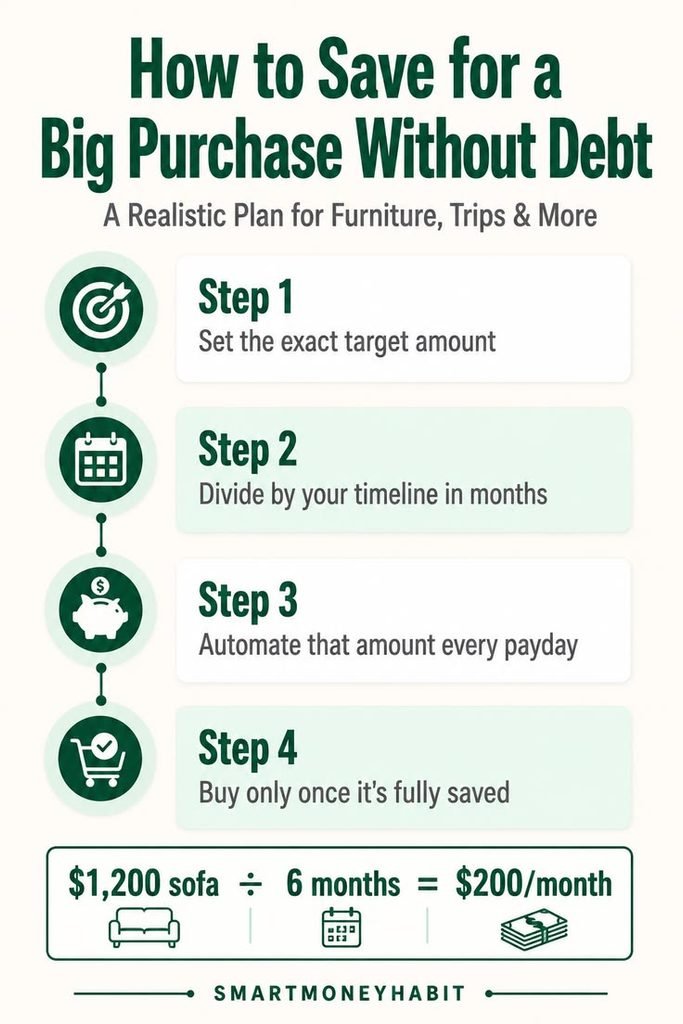
Saving for a large purchase can feel difficult when the price is much higher than what you normally spend. Whether you’re planning to buy a new computer, replace an appliance, purchase a vehicle, pay for education, or prepare for a major trip, having a clear savings plan can make the process much easier.
One of the biggest advantages of saving before making a large purchase is that you give yourself time. Instead of rushing into a decision or relying entirely on borrowed money, you can compare options, understand the total cost, and gradually build the money you need.
The good news is that you don’t necessarily need a high income to start planning for a major purchase. A realistic goal, a suitable timeline, and consistent contributions can help you make steady progress.
What Is a Large Purchase?
A large purchase is an expense that requires more planning than your normal everyday spending.
For one person, a large purchase might be $500. For someone else, it might be $5,000 or more.
Examples include:
- A laptop or computer
- A vehicle
- Furniture
- Home appliances
- Education expenses
- A major vacation
- Professional equipment
- Home improvements
- Electronics
- A wedding or major event
The amount itself isn’t what determines whether something is a large purchase. What matters is how significant the expense is compared with your normal income and budget.
Why Should You Save Before Making a Large Purchase?
Saving before making a purchase can give you greater control over your money.
When you save first, you have time to think about whether the purchase is actually necessary and whether there are more affordable alternatives.
It can also help you avoid taking on unnecessary debt.
Saving in advance may help you:
- Reduce financial pressure
- Avoid unnecessary borrowing
- Compare different products and prices
- Avoid impulse purchases
- Understand the total cost
- Prepare for additional expenses
- Make more informed decisions
The goal isn’t to avoid credit in every possible situation. Instead, it’s to understand the cost of borrowing and avoid taking on debt simply because you haven’t planned ahead.
Step 1: Decide Exactly What You Want to Buy
The first step is to define your purchase.
Instead of saying:
“I want to buy a new computer.”
Create a more specific goal:
“I want to buy a computer that costs around $1,200.”
A specific target makes it easier to calculate how much you need to save.
It also gives you something concrete to research.
You can compare different brands, features, prices, warranties, and alternatives before deciding what to purchase.
Step 2: Calculate the Total Cost
Don’t look only at the advertised price.
Depending on the purchase, there may be additional costs.
For example, a vehicle may involve:
- Insurance
- Fuel
- Maintenance
- Registration
- Repairs
A computer may require:
- Accessories
- Software
- A monitor
- Storage
- Other equipment
A trip may involve:
- Transportation
- Accommodation
- Food
- Activities
- Travel insurance
Before creating your savings target, estimate the total amount you are likely to need.
Step 3: Determine How Much You Already Have
If you’ve already saved some money toward the purchase, subtract it from the total target.
For example:
Purchase target: $2,000
Current savings: $500
Amount remaining: $1,500
Now you know that your actual savings target is $1,500 rather than the full $2,000.
This can make the goal feel more manageable.
Step 4: Set a Realistic Deadline
Choose when you would like to make the purchase.
Suppose you need to save $1,500 over 10 months.
Your basic monthly target would be:
$1,500 ÷ 10 = $150 per month
If $150 per month doesn’t fit comfortably into your budget, you could extend the timeline.
For example:
$1,500 ÷ 15 = $100 per month
A longer timeline can reduce the amount you need to save each month.
Step 5: Add the Goal to Your Budget
Your large purchase should have a specific place in your budget.
For example:
| Category | Monthly Amount |
|---|---|
| Housing | $700 |
| Food | $300 |
| Transportation | $150 |
| Utilities | $150 |
| Regular Savings | $150 |
| Large Purchase Fund | $100 |
| Other Expenses | $200 |
These figures are only an example.
Your own budget should be based on your actual income and expenses.
The important thing is to treat the purchase as a planned financial goal rather than something you’ll figure out later.
Step 6: Create a Separate Savings Fund
If possible, keep money for your large purchase separate from your everyday spending money.
Some banks provide savings spaces, pots, or separate accounts that can be used for different goals.
You could name one:
“New Computer Fund”
or:
“Vehicle Savings”
Having a specific place for the money can make your progress easier to see and may reduce the temptation to spend it on unrelated purchases.
Step 7: Automate Your Savings
If your bank provides automatic transfers, consider using them.
For example, if your target is $100 per month, you could automatically transfer:
$50 after the first payday
and
$50 after the second payday.
This makes saving part of your regular financial routine.
However, always make sure automatic transfers are affordable and don’t cause problems with essential bills or other required payments.
Step 8: Look for Expenses You Can Reduce
You may be able to find additional money by reviewing your current spending.
Look for expenses such as:
- Unused subscriptions
- Frequent takeout
- Impulse purchases
- Unplanned shopping
- Convenience spending
- Services you rarely use
You don’t need to eliminate everything you enjoy.
Instead, identify expenses that aren’t particularly important to you.
For example, if you find $30 per month that you can comfortably redirect toward your goal, that becomes:
$30 × 12 = $360 per year.
Small amounts can become significant when saved consistently.
Step 9: Use Extra Income Carefully
Additional income can also help you reach your target.
Depending on your circumstances, this might include:
- Freelance work
- Overtime
- Selling items you no longer need
- Temporary work
- Bonuses
- Other legitimate income
You don’t have to put every extra dollar toward the purchase.
Instead, decide how much makes sense based on your other financial priorities.
Step 10: Don’t Use Your Emergency Fund for Planned Purchases
An emergency fund and a large-purchase fund serve different purposes.
An emergency fund is intended for unexpected financial situations.
A planned purchase is something you already know about.
For example, if you know that you want to purchase a new laptop in six months, it makes sense to create a separate savings goal for it rather than planning to use your emergency savings.
Keeping these funds separate can help protect your emergency savings.
Step 11: Research Before Spending
One of the biggest advantages of saving ahead of time is that you don’t have to rush.
Use the time to compare:
- Prices
- Features
- Quality
- Warranty terms
- Reviews
- Alternatives
- Running costs
You may discover that a less expensive product meets your needs just as well.
You may also find that prices change over time or that another option provides better value.
Step 12: Avoid Increasing Your Budget
It’s easy to increase your spending target once you start shopping.
You might originally plan to spend $1,000.
Then you find a $1,300 option with additional features.
Then you see another model for $1,700.
Before long, your original goal has changed completely.
Before shopping, decide what features are genuinely important.
Ask yourself:
What do I actually need?
This simple question can help prevent unnecessary upgrades.
Step 13: Give Yourself Time to Change Your Mind
A savings period can also act as a waiting period.
After several months, you may discover that:
- You don’t need the item anymore
- Your priorities have changed
- You found a cheaper alternative
- The item you wanted is no longer available
- You can continue using what you already have
If you decide not to make the purchase, you can redirect the money toward another financial goal.
That’s one of the benefits of saving first: you’re not locked into a purchase simply because you started planning for it.
Step 14: Track Your Progress
Create a simple savings tracker.
For example:
Goal: $1,200
Month 1: $100
Month 2: $200
Month 3: $300
Month 4: $400
Month 5: $500
Month 6: $600
Continue tracking until you reach your target.
You can use:
- A spreadsheet
- A notebook
- A budgeting app
- A savings account
- A simple checklist
Choose the system that you can use consistently.
Step 15: Consider the Ongoing Cost
Before making a major purchase, think beyond the initial price.
Ask:
What will this cost me after I buy it?
For example, buying a vehicle doesn’t end with the purchase price.
There may be ongoing costs such as fuel, insurance, maintenance, and repairs.
Similarly, buying an appliance may involve electricity, maintenance, or replacement costs.
A purchase is easier to manage when both the initial and ongoing expenses fit into your overall budget.
What If You Can’t Save Enough?
Sometimes the required monthly amount simply doesn’t fit your current budget.
That doesn’t necessarily mean you have to abandon the goal.
You have several options.
Extend the Deadline
Give yourself more time.
Lower the Purchase Price
Consider a less expensive option.
Increase Your Savings
Look for realistic ways to reduce expenses or increase income.
Combine Several Strategies
You might reduce your target slightly while also extending the deadline and increasing your monthly savings.
The important thing is to choose a plan that you can realistically maintain.
Example of a Large-Purchase Savings Plan
Imagine you want to buy something that costs $2,000.
You currently have $400 saved.
That leaves:
$2,000 − $400 = $1,600
If you want to reach the goal in 16 months:
$1,600 ÷ 16 = $100 per month
Your plan could therefore be:
Target: $2,000
Current savings: $400
Remaining: $1,600
Timeline: 16 months
Monthly savings: $100
This turns a $2,000 purchase into a manageable monthly target.
Common Mistakes to Avoid
Saving Without a Specific Target
It’s easier to stay focused when you know exactly how much you need.
Setting an Unrealistic Deadline
Don’t choose a deadline that requires more money than your budget can comfortably provide.
Forgetting Additional Costs
Remember that some purchases have ongoing expenses.
Using Emergency Savings
Try to keep planned purchases separate from emergency funds.
Buying Before Reaching Your Goal
If possible, wait until you’ve saved the amount you planned.
Constantly Increasing the Budget
Don’t let every new product you see change your original plan.
Giving Up After a Setback
If you miss a monthly target, review the reason and adjust your plan instead of abandoning it.
Large Purchase Savings Checklist
Before making a major purchase, ask yourself:
- What exactly do I want to buy?
- How much will it really cost?
- Do I already have money saved?
- How much do I still need?
- When do I want to buy it?
- How much can I realistically save each month?
- Can I reduce any unnecessary expenses?
- Are there additional ongoing costs?
- Have I compared different options?
- Do I still need the purchase?
- Will buying it affect my other financial goals?
If you can answer these questions clearly, you’ll have a much better idea of whether you’re ready.
Leave a Reply