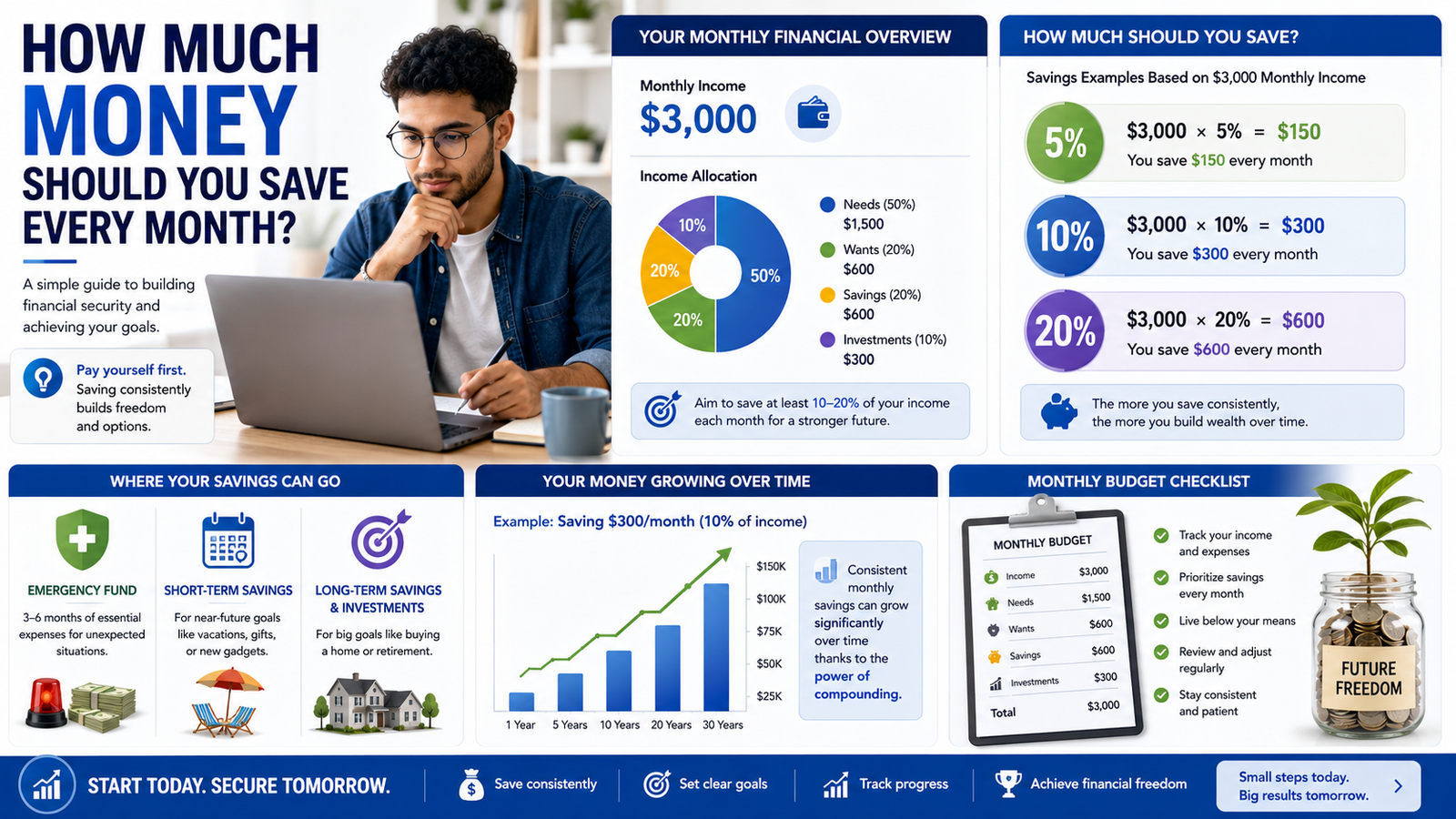
Saving money is one of the most important habits you can develop for your financial future. Whether you are earning a small income, working a full-time job, running a business, or receiving irregular income, regularly setting aside part of what you earn can help you prepare for unexpected expenses and reach important financial goals.
But one question comes up often:
How much money should you actually save every month?
You may have heard that you should save 10%, 20%, or even 30% of your income. While these percentages can be useful starting points, there is no single amount that works for everyone.
Your ideal savings amount depends on your income, expenses, debt, financial responsibilities, and goals.
The good news is that you do not need to start with a large amount. What matters most is creating a savings habit that you can maintain consistently.
Why Is Monthly Saving Important?
Saving money gives you more control over your financial future.
Without savings, an unexpected expense can force you to rely on credit cards, loans, or other sources of borrowed money.
With savings, you have money available for emergencies and planned expenses.
Regular saving can help you:
- Build an emergency fund
- Prepare for unexpected expenses
- Pay for large purchases
- Reduce financial stress
- Prepare for future goals
- Handle temporary income changes
- Avoid unnecessary debt
- Build long-term wealth
Even small amounts can become significant when saved consistently over time.
For example, saving $100 every month means:
$100 × 12 = $1,200 per year
If you continue the habit for five years, you would have contributed $6,000, before considering any interest or investment returns.
Is Saving 10% of Your Income Enough?
A commonly used starting point is saving around 10% of your income.
For example, if you take home $3,000 per month:
10% = $300
Saving $300 every month would give you:
$3,600 per year
For someone just beginning to save, 10% can be a reasonable target.
However, it is not a rule that everyone must follow.
If your essential expenses are already taking up most of your income, saving 10% may be difficult.
In that situation, starting with 2%, 5%, or even a fixed small amount can still help you develop the habit.
What About Saving 20%?
Another popular target is saving 20% of your income.
If your monthly income is $3,000:
20% = $600
Saving $600 every month would mean:
$7,200 per year
A 20% savings rate can provide more room for emergency savings, financial goals, and long-term planning.
However, it may not be realistic for everyone.
Someone with high housing costs, significant debt, or family responsibilities may need to start with a smaller percentage.
The goal should be to save an amount that is both meaningful and sustainable.
The 50/30/20 Rule
One budgeting method that includes a savings target is the 50/30/20 rule.
Under this framework:
- 50% goes toward needs
- 30% goes toward wants
- 20% goes toward savings and certain financial goals
For someone earning $3,000 per month, the 20% savings portion would be:
$600 per month
However, the 50/30/20 framework should be treated as a guideline rather than a requirement.
Your actual financial situation may require a different approach.
For example, someone might temporarily use a 10% savings rate while dealing with high expenses and increase it later.
How Much Should You Save Based on Your Income?
Let’s look at some examples.
If You Earn $1,500 Per Month
Saving 10% would mean:
$150 per month
Saving 5% would mean:
$75 per month
If your expenses are high, starting with $75 may be more realistic.
If You Earn $3,000 Per Month
Saving 10%:
$300 per month
Saving 20%:
$600 per month
If You Earn $5,000 Per Month
Saving 10%:
$500 per month
Saving 20%:
$1,000 per month
The percentage is only one part of the calculation. Your actual expenses and financial responsibilities matter just as much.
Start With Your Expenses
Instead of asking only, “What percentage should I save?” ask:
How much money do I realistically have available after essential expenses?
Suppose your monthly income is $3,000.
Your essential expenses are:
- Housing: $1,000
- Food: $450
- Transportation: $200
- Utilities: $200
- Insurance: $150
- Debt payments: $300
Total essential expenses:
$2,300
That leaves:
$700
You could then decide how to divide the remaining money between savings, personal spending, and other goals.
This approach is often more realistic than blindly choosing a percentage.
Start With an Amount You Can Maintain
One of the biggest mistakes people make is choosing an ambitious savings target that they cannot maintain.
For example, someone may decide to save 30% of their income because they want to reach a goal quickly.
After one or two months, they may become frustrated because the target is too difficult.
A better approach can be to start with a smaller amount.
For example:
Month 1: Save $50
Month 2: Save $75
Month 3: Save $100
Month 4: Save $125
As your financial habits improve, you can gradually increase the amount.
Consistency often matters more than starting with a perfect number.
Build an Emergency Fund First
If you do not have emergency savings, one of your first financial priorities can be creating an emergency fund.
An emergency fund is money reserved for unexpected and necessary expenses.
Examples include:
- Unexpected repairs
- Necessary medical expenses
- Temporary loss of income
- Urgent household costs
- Essential transportation repairs
A common long-term target is to build enough savings to cover several months of essential expenses.
However, you do not have to reach that target immediately.
Start with a small emergency fund and build it gradually.
How Much Should Be in an Emergency Fund?
Suppose your essential monthly expenses are $2,000.
A three-month emergency fund would be:
$2,000 × 3 = $6,000
A six-month fund would be:
$2,000 × 6 = $12,000
The appropriate amount depends on your circumstances.
Someone with a very stable income may have different needs from someone whose income changes frequently.
Save for Short-Term Goals
Not all savings need to go toward emergencies.
You may also have short-term goals.
Examples include:
- A vacation
- A new computer
- A vehicle
- Education
- Moving expenses
- A wedding
- Home improvements
Suppose you want to purchase a $1,200 computer in 12 months.
You could divide the target by the number of months:
$1,200 ÷ 12 = $100
Saving $100 per month would give you $1,200 after one year, assuming the money is not withdrawn and ignoring any interest.
This makes a large expense easier to plan for.
Save for Long-Term Goals
Long-term savings can include goals that are many years away.
Examples include:
- Retirement
- Buying a home
- Education
- Building a business
- Long-term financial independence
The longer your time horizon, the more important it becomes to think about how your savings are stored and whether appropriate investments could play a role.
However, investing involves risk, and the right choice depends on your circumstances, goals, and country.
Before investing money, make sure you understand the risks and costs involved.
What If You Can Only Save a Small Amount?
Do not assume that saving a small amount is pointless.
If you can only save $20 per month, start there.
After one year:
$20 × 12 = $240
If you increase the amount to $50 per month:
$50 × 12 = $600
The purpose of starting small is to establish the habit.
As your income increases or your expenses decrease, you can increase your savings contribution.
What If You Cannot Save Anything?
Sometimes your income may barely cover your essential expenses.
If you cannot currently save, do not assume that you have failed financially.
Instead, focus on understanding why.
Review your expenses and separate them into:
Essential expenses
Important but adjustable expenses
Optional expenses
Look for areas where you can make realistic changes.
You can also consider whether there are legitimate ways to increase your income.
The goal is not to create an unrealistic budget. It is to gradually create a gap between your income and expenses that can eventually be used for savings.
Save Before You Spend
One effective habit is to treat savings like a regular financial commitment.
Instead of spending everything and saving whatever remains, decide on your savings amount first.
For example:
Income: $3,000
Savings: $300
Money available for expenses: $2,700
This approach can make saving more consistent.
If your bank supports automatic transfers, you may be able to schedule a transfer into a separate savings account when you receive your income.
Increase Your Savings When Your Income Increases
A salary increase does not have to mean that all of your additional income goes toward lifestyle spending.
Suppose your income increases by $500 per month.
You could decide to put $200 of that increase toward savings while using the remaining $300 for other priorities.
This allows your lifestyle to improve while your savings also grow.
The same idea can apply to bonuses, freelance income, gifts, or other unexpected money.
You do not necessarily need to save everything.
Saving a portion can still make a difference.
Track Your Savings Progress
Your savings goal becomes easier to follow when you can see your progress.
For example:
Emergency Fund Goal: $5,000
Current savings: $1,500
Progress: 30%
You could update your progress every month.
Seeing the balance increase can provide motivation to continue.
Create Separate Savings Goals
If possible, organize your savings according to different purposes.
For example:
| Goal | Target | Current Savings |
|---|---|---|
| Emergency Fund | $6,000 | $2,000 |
| Vacation | $1,200 | $400 |
| New Computer | $1,000 | $250 |
| Long-Term Savings | $10,000 | $1,500 |
This makes it easier to understand what your money is intended for.
Common Saving Mistakes to Avoid
Saving Only When You Have Extra Money
If you wait for money to be left over, you may find that there is nothing left.
Setting an Unrealistic Target
A savings goal should challenge you without making your entire budget impossible to maintain.
Ignoring Your Debt
If you have expensive debt, you may need to balance saving with paying down the debt.
Using Savings for Everyday Spending
Try to keep money intended for emergencies and long-term goals separate from everyday spending.
Comparing Yourself With Other People
Someone else may be able to save 30% or 40% of their income because their circumstances are completely different.
Focus on your own progress.
A Simple Monthly Savings Plan
Here is an example of how someone earning $3,000 could structure their savings:
Monthly income: $3,000
Emergency fund: $200
Short-term goal: $100
Long-term savings: $150
Total savings: $450
That represents 15% of the monthly income.
There is nothing special about 15%. The point is that the person has created a plan that matches their situation.
How Much Should You Save Every Month?
There is no universal answer.
A useful starting range might be 5% to 20% of your take-home income, depending on your circumstances.
But percentages should be treated as guidelines.
If you can comfortably save 20%, that may be a strong target.
If you can only save 5%, start there.
If you currently cannot save anything, focus first on stabilizing your budget and finding ways to create room for savings.
As your income grows and your financial situation improves, your savings rate can increase.
Leave a Reply