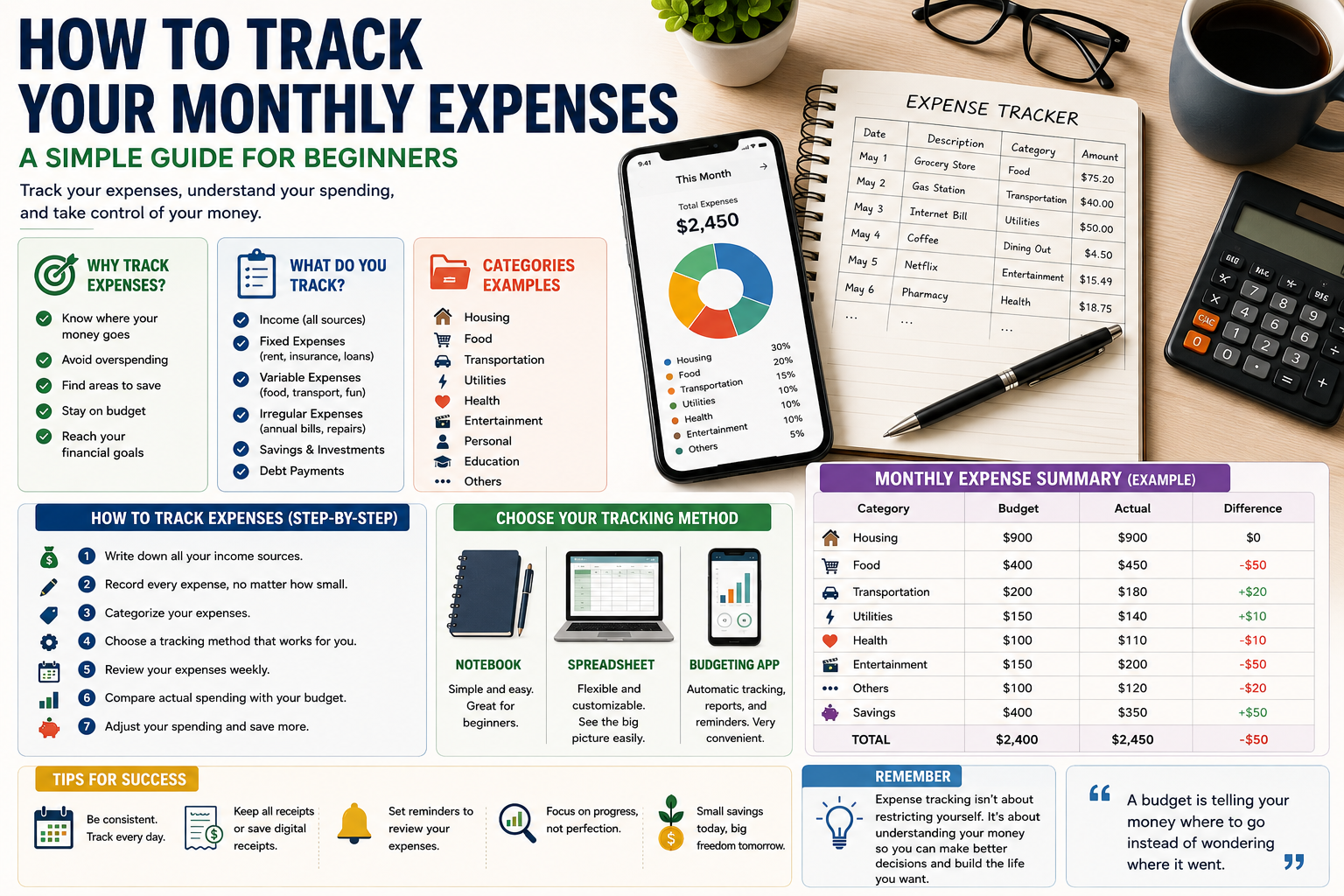
Knowing how much money you earn each month is important, but knowing where that money goes is just as important.
Many people create a budget at the beginning of the month and still struggle to stay on track. One reason is that they do not record their actual spending. Without tracking expenses, small purchases can easily go unnoticed, and by the end of the month, it may be difficult to explain where the money went.
Tracking your monthly expenses gives you a clearer picture of your financial habits. It helps you understand what you spend, identify unnecessary purchases, control your budget, and find opportunities to save.
The good news is that expense tracking does not have to be complicated. You can use a notebook, spreadsheet, budgeting app, or even a simple document on your phone.
In this guide, you will learn how to track your monthly expenses step by step and how to turn your spending information into better financial decisions.
What Does It Mean to Track Your Expenses?
Expense tracking means recording the money you spend and organizing those purchases into categories.
For example, if you purchase groceries for $80, pay $50 for transportation, and spend $25 at a restaurant, you record each transaction.
A simple expense record might look like this:
| Date | Description | Category | Amount |
|---|---|---|---|
| June 2 | Groceries | Food | $80 |
| June 3 | Bus fare | Transportation | $20 |
| June 4 | Restaurant | Dining | $25 |
| June 5 | Internet bill | Utilities | $50 |
At the end of the month, you can calculate how much you spent in each category.
This gives you information that you can use to improve your budget.
Why Should You Track Your Monthly Expenses?
There are several reasons why tracking expenses can be useful.
1. You Can See Where Your Money Goes
It is easy to remember major expenses such as rent, mortgage payments, or utility bills.
Small purchases are different.
You might spend a few dollars here and there on snacks, coffee, transportation, online purchases, subscriptions, or entertainment.
Each purchase may seem insignificant, but repeated spending can become a large amount over several weeks.
Tracking your expenses makes those purchases visible.
2. It Helps You Avoid Overspending
Suppose you decide that you can spend $300 on entertainment during the month.
If you record your purchases, you can see when you are approaching that limit.
Without tracking, you may continue spending without realizing that you have already used most of your available money.
3. It Makes Budgeting More Accurate
A budget should be based on reality.
If you guess that you spend $200 per month on groceries but your records show that you actually spend $350, your budget needs to reflect that.
Expense tracking helps you replace guesses with real information.
4. It Can Help You Find Money to Save
You may discover that some of your spending is not as important as you thought.
For example, you might find that several subscriptions you rarely use are costing you money every month.
Canceling or reducing unnecessary expenses can create additional room for savings.
Step 1: Calculate Your Monthly Income
Before looking at expenses, know how much money you have available.
Add together your regular sources of income.
Depending on your situation, this might include:
- Salary
- Freelance income
- Business income
- Part-time work
- Rental income
- Other regular income
If your income changes from month to month, use a realistic average or conservative estimate.
The goal is to understand how much money you can reasonably expect to have available.
Step 2: Choose an Expense-Tracking Method
There are several ways to track expenses.
The best option is the one you can use consistently.
Notebook
A notebook is one of the simplest options.
Write down the date, purchase, category, and amount whenever you spend money.
This method can work well if you prefer writing things down manually.
Spreadsheet
A spreadsheet provides more flexibility.
You can create columns for:
Date | Description | Category | Amount | Payment Method
You can then calculate totals for each category at the end of the month.
A spreadsheet is especially useful if you want to compare your spending across several months.
Budgeting App
A budgeting app can make expense tracking more convenient because you can record purchases from your phone.
Some apps provide charts and reports that show your spending patterns.
However, you do not need an advanced application.
A simple system that you use regularly is more useful than a complicated system that you abandon after a week.
Step 3: Record Every Expense
This is one of the most important rules of expense tracking.
Record everything.
Do not only record large expenses.
If you spend $5 on a snack, record it.
If you spend $15 on transportation, record it.
If you buy something online for $30, record it.
If you pay for a subscription, record it.
The goal is to create an accurate picture of your spending.
You can record expenses immediately after making a purchase or set aside a few minutes at the end of each day.
Step 4: Create Expense Categories
Organizing your spending into categories makes your records much easier to understand.
Common categories include:
Housing
- Rent
- Mortgage
- Maintenance
- Home repairs
Food
- Groceries
- Restaurants
- Takeaway
- Snacks
- Food delivery
Transportation
- Fuel
- Public transportation
- Ride-hailing
- Parking
- Vehicle maintenance
Utilities
- Electricity
- Water
- Gas
- Internet
- Phone bills
Healthcare
- Medical appointments
- Medication
- Insurance
- Other healthcare expenses
Personal Spending
- Clothing
- Hobbies
- Personal care
- Entertainment
- Shopping
Financial Goals
- Savings
- Investments
- Debt repayment
- Emergency fund
You can add or remove categories depending on your lifestyle.
The goal is to create categories that help you understand your spending without making the system unnecessarily complicated.
Step 5: Separate Fixed and Variable Expenses
Another useful way to organize expenses is to separate them into fixed and variable costs.
Fixed Expenses
These are expenses that usually remain relatively consistent.
Examples include:
- Rent
- Mortgage payments
- Insurance
- Loan payments
- Some subscriptions
Variable Expenses
These expenses can change from month to month.
Examples include:
- Groceries
- Transportation
- Entertainment
- Clothing
- Dining out
- Household purchases
Understanding the difference helps you identify which expenses are easier to change.
You may have limited control over a fixed rent payment, but you may have more flexibility with restaurant spending or entertainment.
Step 6: Separate Needs From Wants
After categorizing your expenses, look at whether each purchase was a need or a want.
Needs
Needs are expenses that are necessary for your basic living or important responsibilities.
Examples include:
- Housing
- Basic food
- Essential transportation
- Utilities
- Necessary healthcare
- Required education expenses
Wants
Wants are purchases that improve your lifestyle but are not essential.
Examples include:
- Entertainment
- Restaurant meals
- New gadgets
- Expensive clothing
- Hobbies
- Vacations
- Optional subscriptions
The goal is not to eliminate every want.
Enjoying your money is part of having a healthy relationship with finances.
The purpose is to understand where your money is going so that you can decide what is worth paying for.
Step 7: Track Different Payment Methods
Do not forget to track the different ways you pay.
You might use:
- Cash
- Debit cards
- Credit cards
- Bank transfers
- Mobile wallets
- Digital payment services
If you only track card purchases, your records will not show the full picture.
Cash spending is particularly easy to forget.
One simple solution is to record cash purchases immediately.
Step 8: Review Your Expenses Every Week
You do not need to wait until the end of the month to review your spending.
Choose one day each week to check your records.
Ask yourself:
How much have I spent this week?
Which category received the most money?
Did I make any unnecessary purchases?
Am I still within my budget?
Do I need to adjust my spending for the rest of the month?
A weekly review can help you identify problems before they become larger.
For example, if you planned to spend $400 on dining during the month but have already spent $300 after two weeks, you know that you need to be more careful for the rest of the month.
Step 9: Compare Planned Spending With Actual Spending
This is where expense tracking becomes especially useful.
At the beginning of the month, you may have planned:
Groceries: $300
At the end of the month, your actual spending might be:
Groceries: $370
That difference tells you something.
Maybe food prices increased.
Maybe you had guests.
Maybe you bought more expensive items.
Or perhaps you simply underestimated your normal grocery spending.
Do the same comparison with your other categories.
Over time, this information can help you create more realistic budgets.
Step 10: Identify Spending Patterns
After tracking your expenses for several months, you may begin to notice patterns.
For example, you might discover that:
- You spend more on weekends.
- Your food spending increases when you order delivery.
- Transportation costs rise during certain periods.
- You frequently make small online purchases.
- Several subscriptions are rarely used.
- Your utility costs change significantly during certain seasons.
These patterns are valuable because they show you where changes could have the greatest impact.
Step 11: Look for Unnecessary Expenses
Once you know where your money goes, review your spending and look for expenses that do not provide enough value.
Ask yourself:
Do I still use this subscription?
Could I buy this item for less?
Do I need to make this purchase right now?
Could I prepare this meal at home?
Am I paying for something simply because I am used to it?
You do not need to eliminate everything.
Focus on expenses that you personally consider unnecessary.
If you find five small expenses that you can reduce, the savings can add up over time.
Step 12: Track Irregular Expenses
Not every expense occurs every month.
Some expenses may happen once or twice a year.
Examples include:
- Annual insurance
- Vehicle repairs
- School expenses
- Holiday spending
- Gifts
- Medical expenses
- Home repairs
- Annual memberships
Ignoring these expenses can make a monthly budget look better than it really is.
Instead, estimate how much you expect to spend throughout the year.
For example, if you expect to spend $600 on irregular vehicle expenses over a year, you could set aside approximately $50 per month.
That way, the expense does not come as a complete surprise when it arrives.
A Complete Monthly Expense Tracking Example
Imagine someone earns $3,000 per month.
After tracking their spending for a month, they discover:
| Category | Planned | Actual |
|---|---|---|
| Housing | $1,000 | $1,000 |
| Groceries | $350 | $400 |
| Transportation | $200 | $220 |
| Utilities | $150 | $160 |
| Insurance | $150 | $150 |
| Debt payments | $250 | $250 |
| Entertainment | $150 | $220 |
| Personal spending | $100 | $140 |
| Savings | $400 | $300 |
| Other expenses | $250 | $260 |
This comparison immediately reveals some useful information.
The person spent more than expected on groceries, transportation, entertainment, personal spending, and other expenses.
At the same time, their savings were lower than planned.
Instead of simply saying that they “spent too much,” they now know exactly where the differences occurred.
They can use this information to adjust the next month’s budget.
How Expense Tracking Can Help You Save More
Tracking expenses does not automatically make you wealthy.
However, it can make financial decisions more intentional.
Suppose you discover that you spend:
- $100 on unused subscriptions
- $150 on frequent food delivery
- $75 on impulse purchases
That is $325 in potentially reducible spending.
You may decide to redirect some of that money toward savings.
Even if you do not eliminate all of these expenses, reducing them can create additional room in your budget.
The important thing is to make changes based on your own spending patterns.
Common Expense-Tracking Mistakes
Only Tracking Large Purchases
Small purchases matter too.
Record them.
Forgetting Cash Purchases
Cash can disappear from your records quickly if you do not write it down.
Tracking for Only a Few Days
A few days of data may not represent your normal spending.
Try to track consistently throughout the month.
Creating Too Many Categories
If you create 30 or 40 categories, the system may become difficult to maintain.
Start with broad categories and add more only when necessary.
Feeling Guilty About Every Purchase
Expense tracking is not meant to make you feel bad about spending money.
It is designed to help you understand your financial habits.
Use the information constructively.
How to Stay Consistent
Consistency is often more important than the tool you use.
Here are a few simple habits that can help:
Record Purchases Immediately
Entering an expense takes only a few seconds.
Set a Weekly Reminder
Choose a specific day and review your expenses.
Keep Your Tracking Tool Accessible
If you use a notebook, keep it somewhere visible.
If you use a spreadsheet or app, make it easy to access from your phone or computer.
Review Before Making Large Purchases
Before making an expensive purchase, check your budget and recent spending.
Keep Improving Your System
Your expense tracker does not need to remain the same forever.
As you learn more about your spending, adjust your categories and goals.
Simple Monthly Expense Tracker Template
You can use this basic structure to start tracking your expenses:
Monthly Income: __________
| Date | Description | Category | Amount | Need/Want |
|---|---|---|---|---|
At the end of the month, calculate your totals for each category.
Then compare those numbers with your original budget.
Leave a Reply